
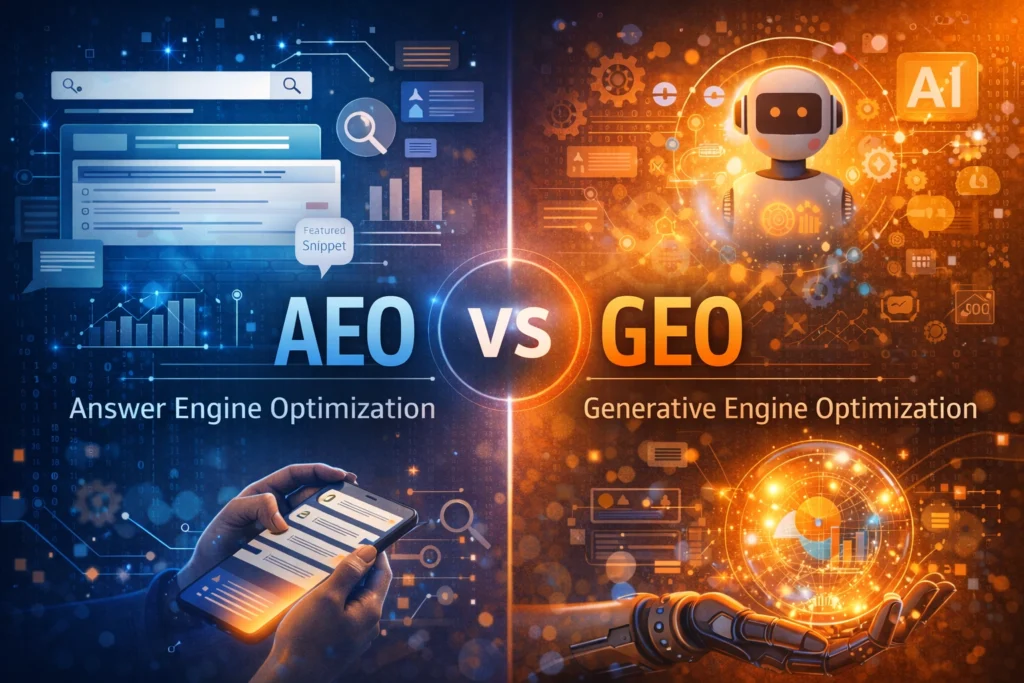
AEO V/S GEO
AEO & GEO: How AI Is Redefining the Future of Digital Marketing Search Digital marketing is changing at a pace we’ve never seen before. Not long ago, success online meant one thing—ranking on Google’s first page. Traditional Search Engine Optimization (SEO) was the foundation of online visibility, and keywords were the driving force behind most marketing strategies. But today, the way people search for information has completely transformed. With the rise of artificial intelligence, voice assistants, and generative search platforms, users are no longer limited to typing short keywords into a search bar. Instead, they ask full questions, speak to their devices, and increasingly depend on AI-generated answers to guide their decisions. Search has become more conversational, more intuitive, and more focused on instant solutions. This shift has introduced two important concepts that every modern digital marketer needs to understand: Answer Engine Optimization (AEO) and Generative Engine Optimization (GEO). Rather than replacing SEO, AEO and GEO build on it. They move the focus beyond rankings and toward how information is delivered and understood. The goal is no longer just to appear in search results, but to become the most relevant answer and a trusted source within AI-driven platforms. For brands and marketers who want to remain visible, credible, and competitive in this new digital era, adapting to AEO and GEO is no longer optional—it’s essential. Understanding the Shift from SEO to AI-Driven Search The old SEO was keyword-based, backlink-based, and ranking position-based. Although these aspects haven’t become obsolete yet, search engines are not simply search engines anymore. They’re fast becoming, or in some cases, already, answer engines and generative engines. These new platforms include the use of Google AI Overviews, ChatGPT, Perplexity, Bing Copilot, as well as voice assistants like Siri or Alexa; their goal is to provide answers rather than pointing towards relevant links for users. “This paradigm shift requires an entirely different method of content development—more focused on clarity, authority, and utility. That’s what AEO and GEO are for.” What Is Answer Engine Optimization (AEO)? Answer Engine Optimization, or AEO, refers to optimizing content so that answers to users’ questions are directly provided in a simple, straightforward, and structured fashion. While the purpose of SEO is merely to place a webpage on a results page, the purpose of AEO is to ensure that search engines and AI choose your content as the best possible answer to their users’ questions. “In essence, AEO is concerned not only with the word the user queried but also with the information the user wants to find out.” How AEO Works AEO works by aligning content with how search engines interpret questions and identify answers. Search algorithms now look for content that is: Clearly structured Easily understandable Directly responsive to a query Written in a natural, conversational manner. Typically, AEO-optimized content will: Question Headings (What, Why, How, When) Briefer, more specific answers, generally ranging from Bullet Points and Numbered Lists FAQ sections Schema Markup (Structured Data) Such structure enables the easy extraction of the most important information on the web page using web crawlers or algorithms of artificial intelligence.Typically, AEO-optimized content will Where AEO Appears AEO-driven content pops up in high-visibility placements like: Google Featured Snippets “People Also Ask” sections Voice search results AI-powered search summaries Not only that, but when your content rises to the top as an answer, it immediately gains authority and trust. AEO-Optimized Pages Typically Includes: Question-based headings (What, Why, How, When) Answer lengths of about 40 to 60 words List formats and stylesOrderedList and Bullet, FAQ sections Schema Markup/Structured Data Schema Markup/ This makes it easier for search engines and AI to rapidly identify the most important information. Where AEO Appears “AEO-driven” content is noticeable through prominent positioning such as: Google Featured Snippets “People Also Ask” sections Responses for voice searching Artificial intelligence-assisted search summaries When your content is chosen as an answer to a question, it gets instant credibility and trust. Why AEO Is Important There’s been a tremendous shift in the behavior of users. Today, users tend to search for their answers in a conversational manner; they tend to use full questions rather than typing a bunch of keywords together. For instance “What is digital marketing?” “How does SEO help small businesses?” “Which marketing strategy is best for local brands?” AEO makes sure that your answers are targeted to satisfy all of these types of searches. This enhances: Publicity Cred Click-through rates Brand authority• In a world with fleeting attention spans, the value of being the solution far exceeds that of simply being one of many search results. What Is Generative Engine Optimization (GEO)? Generative Engine OptimizationThe optimization of the content so that it can be identified, trusted, and utilized by the AI-based generative search engines when they generate answers is termed Generative Engine Optimization (GEO). Unlike conventional search engines that feature rankings of links, the purpose of the new engines is to provide generated replies through the combination of trusted sources. GEO insures that your content is one of those sources. How GEO Works In Generative AI, the evaluation of content written by humans follows a different pattern than in the process Expertise & Authority Context and depthContext Accuracy and clarity Original Insights Human perspectiveBecause GEO-friendly content does not contain keyword repetition or thin content. GEO-friendly content is more of the following Organized with a logical flow Authored by an individual with subject matter knowledge Replete with explanations, examples, and reasoning Updated & factually accurate AIs are designed to ensure that the best available understanding of a subject is provided to the user. If valuable information is provided, it is most probably going to be cited or summarized. Where GEO Appears GEO affects visibility in: ChatGPT answers Google AI Summaries Perplexity answers Bing Copilot summaries AI-powered recommendation engines In these situations, users do not click on any website. Instead, they use AI-driven explanations for everything. GEO is how you integrate your brand or expertise into this explanation. Why GEO Is Critical to the Future